

Meet our Graduate Students!

Cynthia Mendez-Zambrano
MSc Student - University of Saskatchewan
Can Stormwater Retention Ponds Provide Comparable Ecological Functions to Natural Wetlands? – A Biodiversity and Productivity Assessment
This project investigates the role of Saskatoon's stormwater infrastructure in enhancing urban biodiversity and improving ecological health by examining whether stormwater retention ponds (SWRPs) can support ecological functions comparable to those of natural wetlands.
To address this question, Cynthia compares biodiversity and ecosystem productivity between SWRPs and natural wetlands. Biodiversity is assessed using environmental DNA (eDNA) metabarcoding from water samples collected in 31 SWRPs and 5 natural wetlands. Ecosystem productivity is evaluated through measurements of primary production, algal biomass, and insect emergence. This study aims to contribute to conservation efforts by highlighting the ecological value of these systems, promoting the naturalization of stormwater ponds, and raising awareness among residents and pond users. By doing so, key ecosystem services can be enhanced while preserving the essential role of these ponds in urban water management.

Mallory Christenson
MSc Student - University of Saskatchewan
Tracking the Environmental Fate and Transformation of Benzalkonium Chloride in a Boreal Lake Ecosystem
This project focuses on the chemical-analytical determination of the fate and transformation reactions of benzalkonium chloride (BAC) in a whole-lake ecosystem experiment conducted at the IISD–Experimental Lakes Area (ELA). Mallory will analyze water, sediment, and biota samples using ultra-high-performance liquid chromatography coupled with high-resolution Orbitrap mass spectrometry (UPLC-HRMS) to:
(1) Quantify concentrations and distribution of BAC across environmental compartments,
(2) Identify transformation products formed through biological and chemical processes, and
(3) Assess sorption, bioaccumulation, and degradation pathways.
Grace Thomson
MSc Student - University of Manitoba
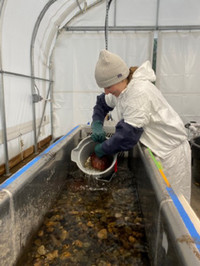
Effects of an Oil Spill Bioremediation Measure on Freshwater Benthic Macroinvertebrate Communities
Dilbit pipeline spills pose risk to many sensitive ecosystems, including those that are inhabited by Pacific Salmon, their main food source (aquatic insects) and other aquatic organisms. Biostimulation is an oil spill remediation technique where excess nutrients are applied to the affected area, with the intent of stimulating the growth of microorganisms able to consume spiled oil.
Grace will characterize the effect of biostimulation on the structure and function of benthic macroinvertebrate communities, thereby better informing oil spill remediation measures and the protection of Pacific Salmon and their main food source, benthic macroinvertebrates (BMI). By exposing BMI to a gradient of nutrient concentrations, the project will evaluate the utility of biostimulation as a remediation measure, and its potential impacts to species diversity and richness, abundance, and community structure.

Lorena Rodríguez Beas
PhD Student - University of Saskatchewan
Assessing and Enhancing Advanced Oxidation Processes for Cleaner Municipal Wastewater in Saskatoon
This project will evaluate advanced oxidation processes (AOPs) as innovative approaches to remove pharmaceutical residues and other emerging contaminants from Saskatoon’s municipal wastewater.
Lorena will perform chemical and toxicological analyses of wastewater before and after treatment, optimize AOP conditions to maximize contaminant removal, and assess the technical and economic feasibility of integrating these processes into the City of Saskatoon’s existing treatment infrastructure. This research will generate actionable insights for sustainable municipal water management, enhance effluent quality, and support evidence-based decisions on emerging contaminant mitigation.

Corwyn Shomachuk
PhD Student - University of Saskatchewan
Understanding Peak Flows Events and Predicting Changing Flood-Generating Mechanisms in the Canadian Prairies
The Prairie Pothole Region (PPR) is a landscape sprinkled with thousands of depressional wetlands and grassland, which play a critical role in the hydrology of the region. Hydrological modeling in the PPR is complex for models due to the limited availability of accurate, large-scale waterbody distribution data, and complex cold region hydrological processes.
Corwyn’s research will address these challenges by integrating remote sensing technologies, artificial intelligence wetland identification models, and advanced hydrological modeling frameworks (Raven) to improve the identification and simulation of waterbodies across the PPR.