
Permafrost Thaw Is Acidifying Streams Across Canada's Subarctic
A new study published in Science finds that thawing permafrost is triggering rapid chemical changes in headwater streams across Canada's Yukon and Northwest Territories, with serious consequences for water quality and aquatic ecosystems.
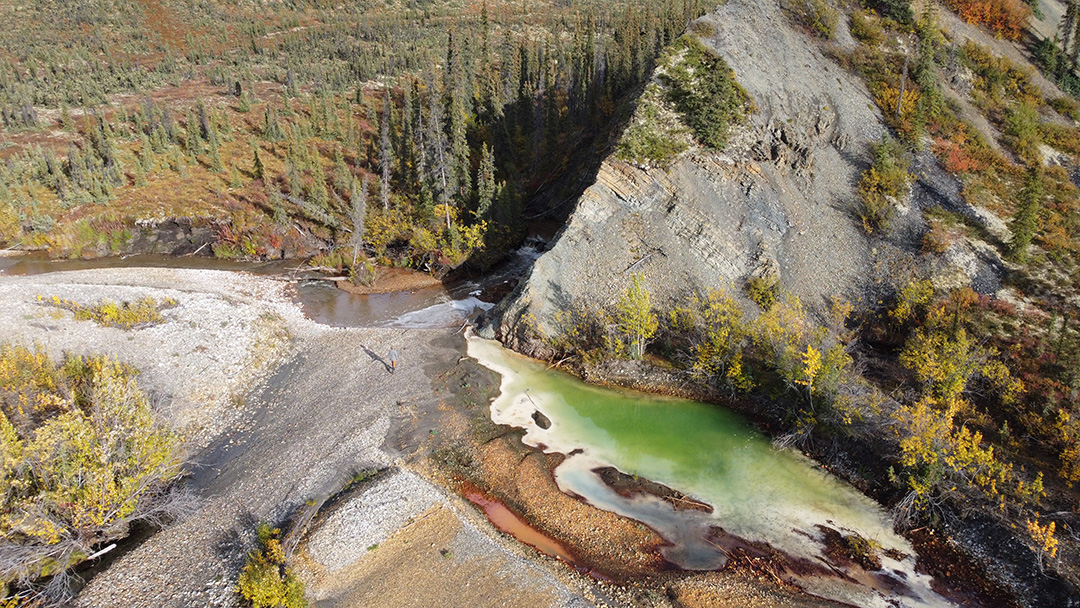
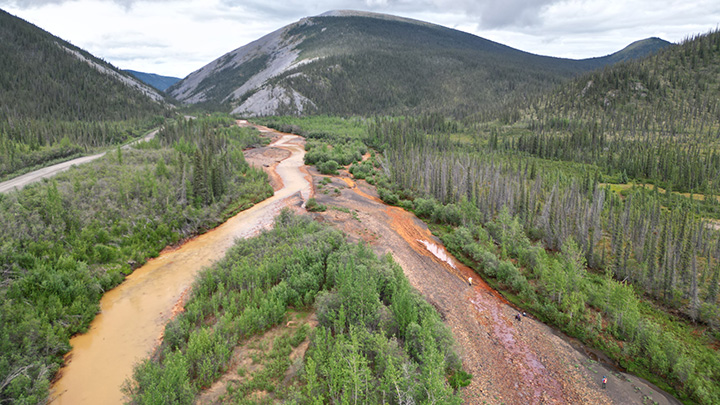
Across the remote subarctic of northern Canada, streams that ran clear with near-neutral pH just a decade ago are now running rusty orange and milky white. The discolouration is a sign of dramatic shifts in water chemistry, which a new study links directly to thawing permafrost.
A study published today in Science by researchers at Carleton University, the University of Saskatchewan, and McMaster University documents a rapid decline in water quality in small headwater streams in Tombstone Territorial Park and the surrounding Ogilvie Mountains of central Yukon. These streams feed into two of North America's largest Arctic river systems, the Yukon River and Mackenzie River, which contribute approximately 20% of river flow to the Arctic Ocean.
What's happening underground
Buried within permafrost are sulfide minerals, which are geologically common and largely inert while frozen. With temperatures increasing by 0.4°C per decade since 1961, the ground has been thawing and these minerals are exposed to oxygen and water, setting off a process called sulfide-mineral oxidation (SMO). The products are acid, sulfate, and dissolved metals, commonly called acid rock drainage (ARD), which are similar to what is produced at poorly managed mine sites.
In the streams the researchers monitored, they recorded pH levels as low as 2.7 (about as acidic as vinegar) and concentrations of metals including zinc, aluminum, cadmium, iron, and nickel that exceed Canadian guidelines for the protection of aquatic life. In some seepage sites, metal concentrations were comparable to those seen at heavily contaminated mine sites.
Visible damage, fast
The effects are visible from space. Satellite imagery analyzed for the study identified 146 discoloured streams across roughly 60,000 square kilometers of the Peel River watershed. On the ground, researchers found large patches of dead vegetation where acidic seeps emerge from hillslopes and saturate the surrounding soil. The largest patch covers more than 90,000 square meters and has appeared within the last decade.
The study found that even a small ARD source can dominate an entire stream's chemistry. Vegetation diebacks mark where SMO is most active at the surface. In one monitored catchment, a dieback covering just 0.02% of the total watershed area was enough to control the water chemistry of the stream below it.
An abrupt shift, not a gradual one
The researchers describe the water quality changes as a sudden shift rather than a slow decline. Some streams had stable, healthy chemistry for years and then deteriorated rapidly within a single season. One stream measured at pH 7.5 as recently as 2022 dropped to 2.7 by 2025. This is similar to what happens at some mine sites when the ground can no longer neutralize acid. After that point, water quality declines quickly and can stay that way for a very long time.
(Photo credit: Matthew Lindsay)
A problem that compounds itself
The consequences extend beyond water quality. When sulfuric acid reacts with carbonate rocks in the landscape, it releases carbon dioxide. One catchment in the study is estimated to be emitting CO₂ at a rate equivalent to the daily emissions of roughly 1,100 people.
This means permafrost thaw does not only respond to climate change, it can also contribute to it.
These changes are already being detected beyond small streams. Downstream, large rivers like the Peel and Ogilvie remain buffered enough to stay alkaline, but their sulfate concentrations have been rising for decades. In the Peel River, the rate of sulfate increase has doubled since 2000 compared to the two preceding decades.
Implications for a large region
The geological terranes most vulnerable to this process extend across more than 1.1 million square kilometers of western North American permafrost, from northern Alaska through the Yukon and Northwest Territories. As warming continues, the researchers caution that the acute water quality changes now observed in headwater streams are likely to become more widespread.
"Once initiated, ARD can persist for millennia," the authors note, drawing a comparison to the major changes in sulfur cycling at end of the last Ice Age.
The study, "Abrupt stream acidification and metal mobilization from permafrost degradation," was published in Science on May 21, 2026. Authors Elliott Skierszkan (Carleton University) and Matthew Lindsay (USask) are members of GIWS. The research was funded by the Natural Sciences and Engineering Research Council of Canada, Global Water Futures (Canada First Research Excellence Fund), Global Water Futures Observatories (CFI-MSI; Tombstone Water Observatory), and the Canada Water Agency. The study area overlies the traditional territory of the Tr'ondëk Hwëch'in and the First Nation of Na-Cho Nyäk Dun.
Learn more about 'Rusting Rivers' at www.rustingrivers.ca
In the media: