
Putting Green Roofs to the Test in Saskatoon’s Climate
In Saskatoon’s harsh climate, researchers are putting green roofs to the test to understand how they can succeed in cold, dry conditions.
Since 2018, researchers at the Multi-purpose Soil Testing (MOST) Facility, part of the Global Institute for Water Security and Department of Soil Science at the University of Saskatchewan, have been testing a question no one has answered before: Can green roofs survive - and thrive - in cold, dry climates like the Prairies?
The Green Roof Environment and Engineering (GREEN) project replicates rooftop conditions to understand how soil depth, composition, plant species, temperature, and water availability affect green roof performance in Saskatoon’s challenging environment. With long, frigid winters, short hot summers, and limited precipitation, the city offers a natural laboratory for pushing the limits of green roof design.
Researchers hope that their findings will help inform building practices, encourage greener urban spaces, and make green roofs more practical across Canada’s cold regions. We asked Cody Millar, Facility Manager at MOST, what the team is exploring around green roofs in Saskatoon.
1. What benefits, beyond aesthetics, can green roofs provide to urban areas?
Beyond aesthetics, green roofs offer several practical benefits to urban areas. One of the biggest is that they help reduce the urban heat island effect, cooling and insulating buildings, and lowering energy use. Green roofs also absorb and store rainwater, which helps reduce stormwater runoff and, when used at larger scales, can lower flood risks when paired with good urban planning and stormwater management. Additionally, they improve air quality, provide urban habitats for pollinators, and extend the lifespan of roofing materials by limiting direct exposure to UV radiation.
2. Why study green roofs in Saskatoon?
Saskatoon offers a unique and challenging climate compared to Canada’s other green roof testing sites in Vancouver and Toronto. Before the construction of the GREEN project at MOST, there wasn’t a dedicated “cold climate” testing facility for these systems. Our region experiences long, cold winters, short (but often hot) growing seasons, and variable precipitation, all of which present demanding conditions for green roofs. Establishing a testing site in Saskatoon allows us to refine system designs that can not only withstand but thrive in these conditions. This hopefully can inform locally focused design solutions to deliver the full range of green roof benefits in cold-climate cities.
3. What key design and performance questions are driving this green roof research?
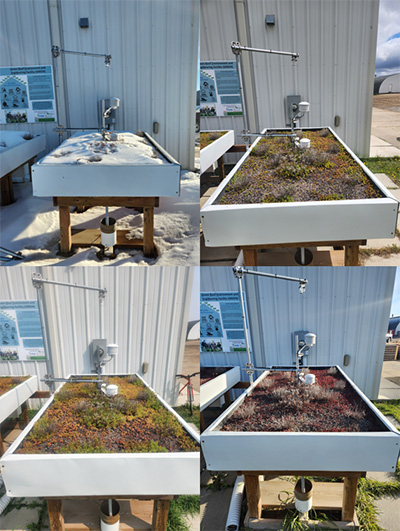
The GREEN project at MOST was Canada’s first research site designed specifically to test green roofs in a cold climate. Over the first four years of research, the project explored fundamental topics such as: what depth and type of soil is needed to hold enough water for plants while still adequately insulating roots through winter; which plant species can survive the extreme Prairie climate; and can these species thrive on rainfall alone (without irrigation).
To answer these questions, MOST built eight test roofs copying the systems developed at the University of Toronto GRIT lab, using a simple, low-cost design of wood framing, waterproof membrane, and drainage tile. The test roofs varied in soil depth (10 cm or 15 cm) and soil blends that combined Soprema's engineered Soprafol X substrate with locally available biochar and shale. Use of regional materials reduces costs, carbon footprint, and supports local suppliers. Testing variations in soil depth helps determine how little soil could be used while still maintaining plant water and insulation needs which helps minimize rooftop load and construction costs.
Four hardy, drought-tolerant, self-propagating species of Sedum were planted and left to survive on natural rainfall and snowfall, with the roofs raised one metre above the ground to eliminate the insulating effect of building heat thereby exposing them to the harshest possible winter conditions. After seven years, two of the four species continue to thrive across both soil depths.
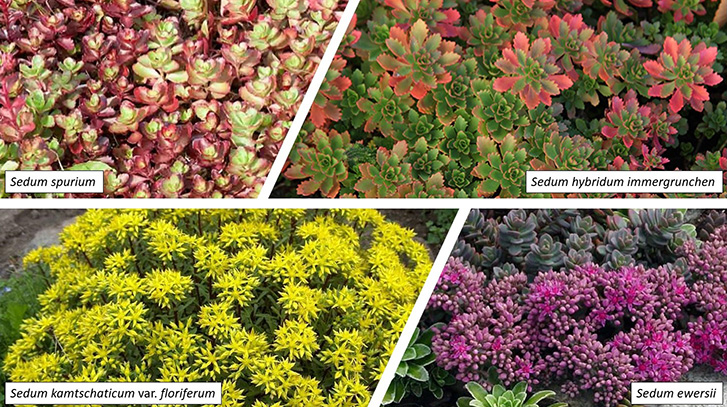 Sedum, also known as stonecrop, is a genus of hardy, and drought-tolerant leafy succulents used for green roofs due to their low maintenance and ability to survive in low-water conditions by storing water in their leaves.
4. What are the biggest challenges to implementing green roofs on existing buildings in Prairie cities?
While this is outside my expertise, conversations with design and construction professionals suggest that cost is the main challenge in retrofitting existing buildings with green roofs. Soil, stored water, and plants add significant weight, meaning older buildings need structural upgrades before a green roof can be installed, which is often expensive. In Canada and Europe, this can mean paying 10–50% more than a regular flat roof, and sometimes much more for deeper or more complex systems.
For new buildings, when green roofs are included in the design from the beginning, the structure can be built to support the weight from the start, reducing costs significantly. Some European studies show that when planned early, green roofs add only a small percentage to the total construction budget because long-term energy savings and a longer-lasting roof help offset the upfront investment. Other clear benefits green roofs offer are improved insulation, urban cooling, and stormwater management, making them increasingly practical for future building projects.
5. How are students involved in the project, and what kind of hands-on experience do they gain?
More recently, our research has shifted toward understanding how green roofs store and release water. Graduate students in the Master of Water Security program are using stable isotope tracing (hydrogen and oxygen isotopes) to distinguish between “new” rainfall and “old” stored soil water released from the green roofs during and following rain events. This work helps quantify how effective green roofs are at buffering stormwater runoff and can inform urban stormwater management and future city planning models.
The MOST facility is part of Global Water Futures Observatories, Canada's premier national freshwater research facility.
Learn more about GREEN project at: https://mostfacility.usask.ca/green/
Did you know?
- City of Saskatoon hosts a Storm Water Management Credit Program for multi-residential and non-residential property owners. Learn more at: https://www.saskatoon.ca/services-residents/power-water-sewer/storm-water/storm-water-management-credit-program
- City of Saskatoon hosts a Rain Barrel Rebate Program. Learn more here: https://www.saskatoon.ca/environmental-initiatives/community-resources/rain-barrel-rebates