
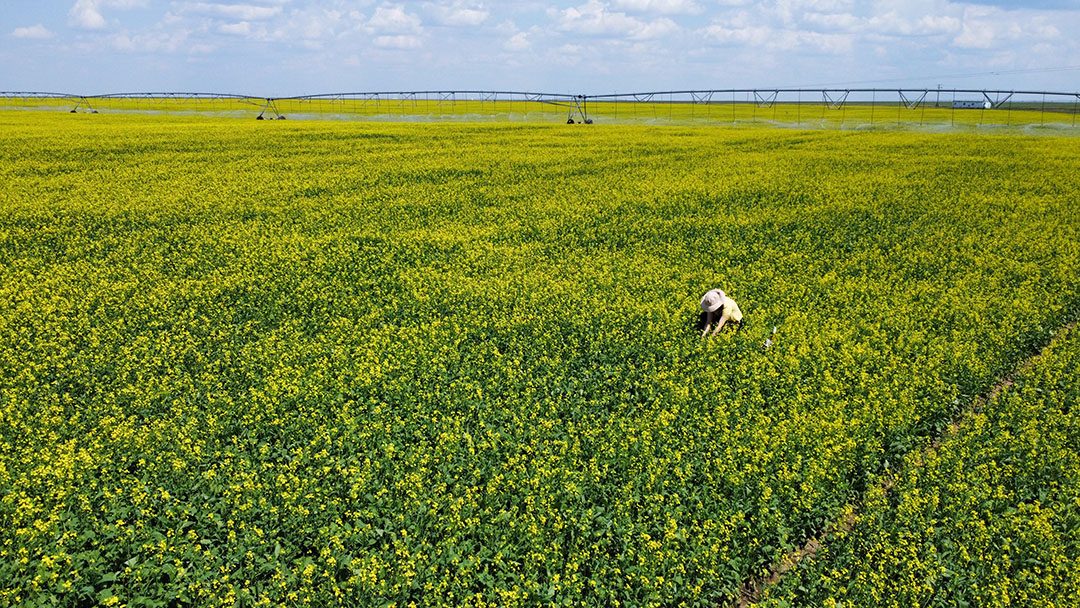
Understanding Climate Impacts on Canola Through Farmers’ Eyes
Drawing on farmer insights, new research highlights how climate variability is affecting canola production and the strategies producers are using to respond.
Climate variability and climate change are reshaping how crops are grown across the Canadian Prairies. Canola, one of the region’s most important crops, is no exception. As part of her PhD research with the Department of Civil, Geological and Environmental Engineering at the University of Saskatchewan, Yohanne Gavasso Rita set out to better understand what these changes look like from the farmer’s perspective using surveys and interviews to understand how shifting weather patterns and growing conditions are affecting their operations.
Published in Plant-Environment Interactions, this study offers a perspective on both the challenges farmers are facing and the practical decisions they are making in response. It also points to the kinds of supports producers say would make a difference as conditions continue to change.
We spoke with Yohanne about why she focused on canola, what she’s hearing from farmers, and how this work fits into her broader research on climate and agriculture.
What made canola an important crop to focus on for this research in the Prairie context?
Searching for something meaningful for Canadian agriculture, I found canola (CANadian Oil Low Acid). It was developed by Canadian researchers aiming to create a healthy oil for human consumption approximately 60 years ago. Nowadays, canola greatly contributes to Canadian economy, through seed and oil development, exports, and biofuel production, becoming a staple for humans, animals, and the renewable energy sector. Moreover, Canada is rich in land and water resources, especially in the Prairie region where more than 80% of the Canadian farmland is producing. The region is characterized by relatively dry conditions and high climate variability, which compromises crop production, water availability, and water quality. Hence, addressing the future of canola production in the Prairies would allow me to develop impactful and important data for the sector.
Based on your conversations with producers, what changes are they noticing most when it comes to weather patterns and growing conditions?
In the last 30 years, canola producers have experienced an increase in extreme weather events during the planting season, including floods, heat waves, wildfires, and wind gusts. During the harvest season, producers have noticed an increase in short-period droughts and heat waves, along with a decline in frost events. Following the geographic patterns across the Prairies, producers have reported more observations of short-period droughts in Saskatchewan and less in Manitoba.
Large losses in canola growth and yield have most often been associated with prolonged drought, heat waves, hailstorms, and floods. Moderate and severe losses due to short-period drought were reported in Saskatchewan and Manitoba, respectively, while severe losses from prolonged drought were only observed in Saskatchewan.
What kinds of adaptation strategies are farmers using to maintain canola production in the face of climate variability?
Most of the producers reported:
- implementing a drainage plan to avoid water logging and soil erosion (mainly in MB)
- changing the planting dates to accommodate the weather conditions and water availability
- diversifying crop rotations to avoid pest and disease attacks and better tolerate the weather variability
- using reduced or no tillage to improve soil health and water retention
- investing in improved seed genetics, buying more tolerant seeds, as well as monitoring tools for weather conditions
- using a fertilization plan to ensure nutrient absorption
- having an insurance plan.
Most of the participants did not find implementing an irrigation plan viable:
From the growers’ and experts’ perspective, what types of support, tools, or policy changes would help them better respond to climate-related challenges?
Producers and experts would like to see more data availability through easy and modern channels. They also recognized the need for more funded research and pilot-level testing to better support the implementation of beneficial agronomical practices and improve climate-smart farms. They indicated a preference for more involvement in land and water management, where they would be able to collaborate with more viable regulations to speed and ease approval for irrigation or drainage plans. In addition, they showed interest in a public policy regarding the seed market and company trial transparency to avoid a market concentration.

How does this study build on or connect to your broader research on climate change and agricultural systems?
In our broader research, we bridged the disconnect between scientific research and producer realities by bringing real field management to crop modelling. In these future predictions, we simulated canola performance in the Prairie Region from 2025 to 2050. We found that the combination of short-period droughts with heat waves may reduce canola yields by up to 20% under rainfed systems. Hence, understanding which field management plans and adaptation strategies are viable to producers and what stresses the crops will face in the future are essential to support crop production and food security.
Read more about Yohanne’s research here: https://doi.org/10.1002/pei3.70107
Additional Resources:
- Initial Exploration of Canola Producers' Approaches in Response to Changing Climate in the Canadian Prairie Provinces (infographic)
- Rainfed Spring Canola Yield Response to Changing Heat and Water Stress in the Canadian Prairie Region(infographic)
- Relevant publications:
- Gavasso-Rita, Y. L., Zaerpour, M., Abdelmoaty, H., Li, Y., Elshorbagy, A., Schuster-Wallace, C., ... & Papalexiou, S. M. (2025). Rainfed spring canola yield response to changing heat and water stress in the Canadian Prairie region. Agricultural Water Management, 322, 109966. https://doi.org/10.1016/j.agwat.2025.109966
- Gavasso-Rita, Y. L., Abdelmoaty, H., Li, Y., & Papalexiou, S. M. (2025). Performance of current canola (Brassica napus) hybrids under future rainfed production management. Journal of Agriculture and Food Research, 102574. https://doi.org/10.1016/j.jafr.2025.102574