

USask graduate students recognized at national hydrology conference in Halifax
Zoë Johnson and Alana Muenchrath were nationally recognized for their award-winning research on prairie snow dynamics and northern permafrost systems.
Two University of Saskatchewan (USask) graduate students received national recognition for their research at the Canadian Geophysical Union (CGU) and International Association of Hydrogeologists Canadian National Chapter (IAH-CNC) conference, held in Halifax, Nova Scotia in late May.
Zoë Johnson and Alana Muenchrath, both members of the Global Institute for Water Security, were honoured for their contributions to advancing understanding of Canada’s changing water systems.
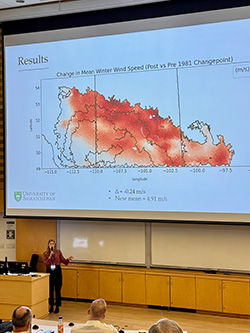
at CGU and IAH-CNC conference in
Halifax, NS. (submitted)
Johnson, a PhD student in the Department of Geography and Planning, was awarded the Don Gray Scholarship. The award recognizes outstanding graduate research in water-related fields and supports emerging scientists working to address critical hydrological challenges.
Her research focuses on snow regimes across the Canadian Prairies, examining how patterns of accumulation and melt are shifting in response to climate change. Snow plays an essential role as a water resource in the region, especially for agriculture, yet it is often overlooked in broader water discussions.
“I feel excited and honoured for my research to be recognized,” Johnson said. “Snow is so easily overlooked when we talk about water, but it is an integral aspect of Canadian hydrology. I am proud that the significance of our work has been celebrated by the hydrological community.”
Johnson noted that her work builds on important modelling efforts by colleague Peter Lawford. She credits both Lawford and supervisor Dr. John Pomeroy for their contributions.
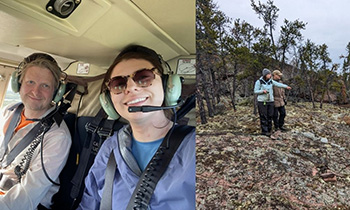
Andrew Ireson (left) and Chris Spence (right).
(submitted)
Muenchrath, a PhD candidate in the School of Environment and Sustainability (SENS), received the D.M. Gray Award for Best Student Paper in Hydrology. The award recognizes excellence in student-led research presented at the conference.
Her award-winning paper, titled The Role of Advective Heat Transport on Ground Thaw in a Permafrost Hillslope in the Taiga Shield, Northwest Territories, examines the processes driving permafrost thaw in the Yellowknife region. The work is currently being developed into a manuscript for publication.
Muenchrath’s research investigates how hydrological processes influence thawing permafrost, a growing concern across northern regions as temperatures rise. Changes in permafrost have far-reaching implications for communities, water quality, ecosystems and carbon release.
“I think the paper was impactful because it presents field observations that quantify hydrological and energy fluxes that are fundamental to permafrost systems,” she said. “It advances our process-level understanding of permafrost thaw using observations from an understudied region.”
Reflecting on the recognition, Muenchrath said the award marked a meaningful milestone as she nears completion of her doctoral work.
“I was extremely grateful and honoured to receive this award,” she said. “I am currently in the final year of my PhD, so it’s incredibly rewarding to see years of fieldwork come together to tell a story that others find meaningful. Contributing to the field of hydrology and improving our understanding of northern environmental change has always been my goal, making this recognition particularly special.”
She also acknowledged the support behind her research, thanking her supervisors, Dr. Andrew Ireson (SENS, GIWS) and Dr. Chris Spence (Environment and Climate Change Canada), along with the many contributors involved in fieldwork over the years.
The recognition of both students highlights the strength of water research at USask and the growing importance of understanding hydrological systems in a changing climate. From prairie snow dynamics to northern permafrost processes, their work addresses key questions about Canada’s water future and its impact on communities and ecosystems.