
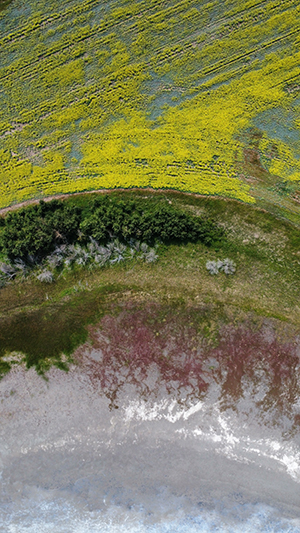
Located within the Canadian Prairies, GIWS members continue to lead research and innovation at the intersection of agriculture and water. This region is one of the most productive agricultural regions in the world, but it also faces growing pressure from climate variability. Saskatchewan alone accounts for more than 40% of Canada’s cultivated farmland and supports a nearly $20 billion annual agri-food industry, yet it faces significant water challenges, including semi-arid conditions, seasonal flooding, saline soils, variable groundwater, and recurring drought. Together, these factors make the region an ideal setting to develop and apply new approaches to managing water in agriculture under increasing climate pressures.
By advancing research at the agriculture-water nexus, water researchers at USask support producers, communities, and ecosystems while contributing solutions that are globally relevant. Many of the same climate, production, and water challenges are shared by agricultural regions around the world. By working closely with partners and focusing on practical outcomes, GIWS is helping show how better water management can support both sustainable agriculture and long-term water security.
A critical advancement has been to establish a GIWS-WSA Research Liaison in agriculture water management to bridge between research and water management in Saskatchewan. The role is currently held by Jillian Brown, Director of Program Advancement with the Saskatchewan Water Security Agency (WSA), who spends ½ day a week at GIWS to strengthen interagency relationships and foster collaborative research initiatives.
Ongoing Research and Initiatives
GIWS researchers are leading a range of projects that address the key challenges at the intersection of agriculture and water. Working closely with producers, government, and industry partners, these initiatives are designed to deliver practical, science-based solutions:
In partnership with the Water Security Agency and Outlook CAN-SK Irrigation Diversification Centre, with funding from the Agriculture Development Fund, this project is exploring the benefits of and barriers to flexible irrigation allocation in Saskatchewan (Lead: Dr. Warren Helgason).
In partnership with Irrigation Saskatchewan and the Water Security Agency, with funding from the Agriculture Development Fund, this project is developing economic models to improve producer outcomes and sustainable agricultural water management in Saskatchewan (Lead: Dr. Pat Lloyd-Smith)
Converting locally available biomass from crop residues (e.g., stalks, hulls) into bio adsorbents that can be used to treat water for multiple uses, including drinking water (Lead: Dr. Lee Wilson)
Researchers
GIWS brings together a diverse group of researchers with expertise spanning hydrology, climate science, agriculture and bioresources, engineering, and social sciences. They collaborate to better understand the complex connections between water and agriculture systems and develop practical solutions to support more sustainable and resilient water use.
Ag-Water Network at USask
GIWS researchers represent and partner with world class facilities at USask, including:
- Global Water Futures Observatories
- College of Agriculture and Bioresources
- Global Institute for Food Security
- Outlook CAN-SK Irrigation Diversification Centre
- Canadian Centre for Rural and Agricultural Health (CCRAH)
- Canadian Light Source
Research Highlights
Reports
Theses
Infographics
Past Research Programs
- Prairie Water (a Global Water Futures project)
- Agricultural Water Futures (a Global Water Futures project)
Key Publications
Observations and management implications of crop and water interactions in cold water-limited regions. Journal of Hydrology.
A practitioner-oriented regional hydrology data product for use in site-specific hydraulic applications. Scientific Data.
Characterization and summary of the 1999–2005 Canadian Prairie drought. Atmosphere-Ocean.
Factors controlling soil water storage in the hummocky landscape of the Prairie Pothole Region of North America. Canadian Journal of Soil Science.
Groundwater table prediction and seasonal variation influenced by short rotation willow plantation on marginal riparian lands of the Prairie potholes in …. Geoderma Regional.
Reliability model for designing solar-powered center-pivot irrigation systems. Transactions of the ASABE.
Implications of stubble management on snow hydrology and meltwater partitioning. Canadian Water Resources Journal / Revue canadienne des ressources hydriques.
Managing excess water in Canadian prairie soils: A review. Canadian Journal of Soil Science.
Drivers of soil carbon variability in North America’s prairie pothole wetlands: A review. Wetlands.
How spatial patterns of soil moisture dynamics can explain field‐scale soil moisture variability: Observations from a sodic landscape. Water Resources Research.
Estimating field-scale root zone soil moisture using the cosmic-ray neutron probe. Hydrology and Earth System Sciences.
Sulfate salt dynamics in the glaciated plains of North America. Journal of Hydrology.
Short rotation willow on the Prairie Potholes' degraded marginal riparian lands: A potential land‐use practice to manage soil salinity. Land Degradation & Development.
Spatial prediction and mapping of soil salinity using machine learning and remote sensing covariates. Canadian Journal of Soil Science.
Soil nitrogen and phosphorus dynamics and uptake by wheat grown in drained prairie soils under three moisture scenarios. Soil Science Society of America Journal.
Eggshell incorporated agro-waste adsorbent pellets for sustainable orthophosphate capture from aqueous media. RSC Sustainability.
Initial Exploration of Canola Producers' Approaches in Response to Changing Climate in the Canadian Prairie Provinces. Plant‐Environment Interactions.
Rainfed spring canola yield response to changing heat and water stress in the Canadian Prairie region. Agricultural Water Management.
Performance of current canola (Brassica napus) hybrids under future rainfed production management. Journal of Agriculture and Food Research.
Assessment of agricultural adaptations to climate change from a water-energy-food nexus perspective. Agricultural Water Management.
Public willingness to pay for wetland restoration in the Canadian Prairie Pothole Region. Canadian Journal of Agricultural Economics/Revue canadienne d'agroeconomie.
Synthesis of science: findings on Canadian Prairie wetland drainage. Canadian Water Resources Journal / Revue canadienne des ressources hydriques.
Education & Training
Food-Water Nexus Education and Training (FWNET) Program
The FWNET is an interdisciplinary graduate training program led by GIWS and funded by the Natural Sciences and Engineering Research Council of Canada – Collaborative Research and Training Experience (NSERC CREATE). The program is designed to train the next generation of researchers and professionals to work across disciplines, bringing together water science, agriculture, policy, and technology to address challenges related to food and water security.
Sustainable Irrigation Program
Led by the College of Agriculture and Bioresources, the Sustainable Irrigation program is a non-credit community-level program. Learners have the option to use their completed courses in this program towards two different micro-credentials:
- Sustainable Irrigation - Irrigation Agronomy
- Sustainable Irrigation - Water Management